The Science of Plastic
How Much Nanoplastic Do Bottled Water Habits Actually Deposit?
A 2026 model estimates how nanoplastics from single-use bottles build up in your tissues over a lifetime — and why heavy consumers face far higher exposure.
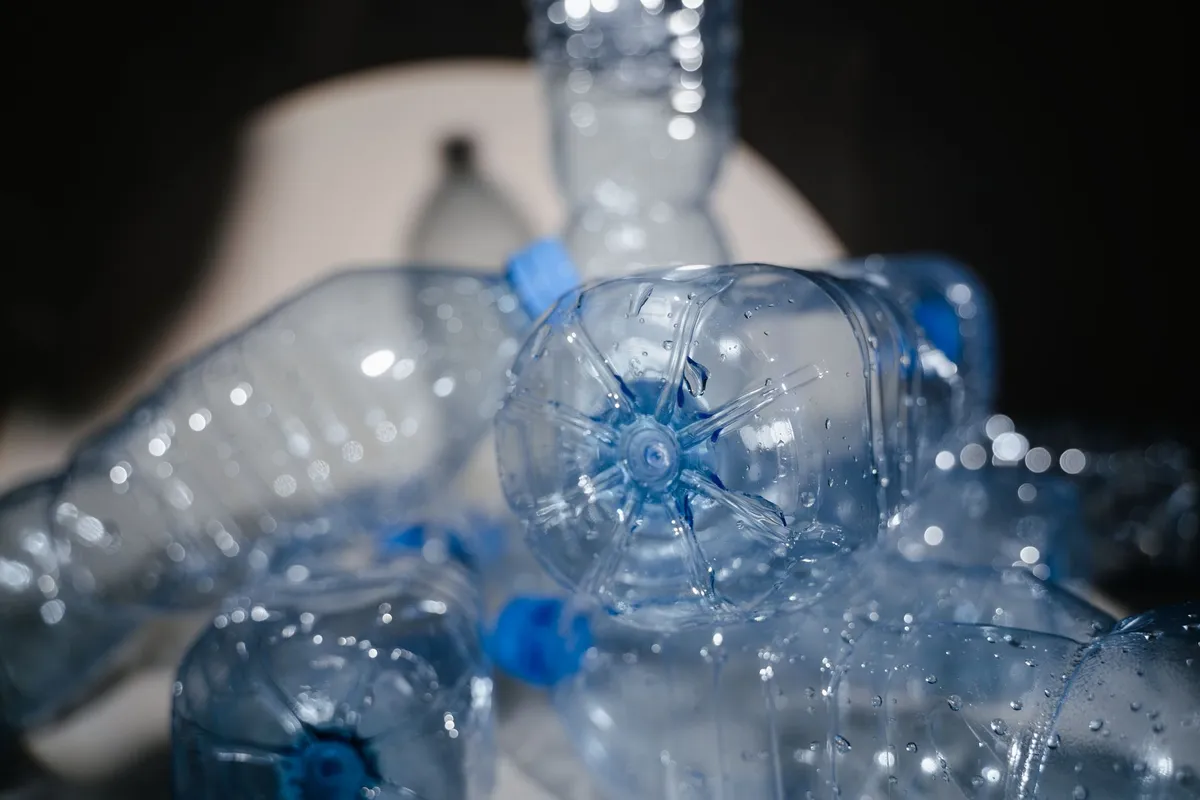
Every minute, people around the world buy roughly a million single-use plastic water bottles — about 1.3 billion a day, according to the UN Environment Programme figures cited in a 2026 modeling study published in Environmental Systems Research.[Environmental Systems Research, 2026] The question that study set out to answer is one almost nobody has quantified: if you drink from those bottles for years, how much nanoplastic actually ends up inside you?
Nanoplastics — plastic particles smaller than one micrometer — have already been detected in human blood, lungs, placenta, and the gastrointestinal tract. But their transport, absorption, and excretion in the body remain largely unknown, and no reference exposure levels have been established.[Environmental Systems Research, 2026] This paper is the first to isolate single-use water bottles as a distinct exposure pathway and model the resulting whole-body tissue burden.
What the study actually measured
The researchers used the “Plastic Model” module of the Human Exposure and Absorption Simulation Interface (HEASI), a kinetic mass-balance toolkit originally built for microplastics. They adapted it for nanoplastics by adjusting parameters like intestinal absorption, biliary excretion, and stool-loss rates, then ran it under steady-state conditions — the point where intake and clearance balance out to a stable long-term level.[Environmental Systems Research, 2026]
Intake data came from an original survey of 15,000 people, which sorted respondents by how many 500 mL bottles they consumed per month. The categories ranged from light users (1–9 bottles/month, about 28.5% of respondents) up to heavy users (50+ bottles/month, about 13.1%), plus a modeled upper-bound “120+” group assuming 2 liters of bottled water per day.[Environmental Systems Research, 2026]
0.00084–226.68 μg/L
Modeled steady-state nanoplastic burden in tissues, across all scenarios
Three exposure scenarios, five orders of magnitude apart
Because measured nanoplastic concentrations in bottled water vary wildly between detection methods, the authors built three scenarios instead of averaging.[Environmental Systems Research, 2026]
Scenarios 1 and 2 used the minimum and maximum concentrations from a 2024 study that detected particles larger than 100 nm using stimulated Raman scattering — 1.10 × 10⁵ and 3.70 × 10⁵ particles per liter.[Environmental Systems Research, 2026] Scenario 3 drew on a 2023 study using surface-enhanced Raman spectroscopy, which reported dramatically higher counts of roughly 1.0 × 10¹¹ particles per liter.[Environmental Systems Research, 2026]
That six-orders-of-magnitude gap is the single most important thing to understand about the results. In Scenarios 1 and 2, modeled tissue burdens ranged from as few as 4 to about 44,731 particles per capita. Under Scenario 3, the heaviest consumers reached modeled burdens between 4.07 × 10⁶ and 1.21 × 10¹⁰ particles per capita.[Environmental Systems Research, 2026] The high-exposure model isn’t slightly worse than the low one — it’s a different universe.
The dose-dependent trend
Across scenarios, a consistent pattern emerged: the more bottles a person consumed, the higher their modeled tissue concentration. A logarithmic analysis showed tissue concentrations clustering by both consumption level and exposure scenario, with the highest-consumption Scenario 3 groups grouping together at the top of the range.[Environmental Systems Research, 2026]
The authors also compared their output against the earlier microplastic model it was built on. For the lower and moderate scenarios, the results aligned closely with prior microplastic estimates — which the authors read as validation of their steady-state equations. But Scenario 3’s values ran nearly twice as high, indicating a potential concern under extreme exposure.[Environmental Systems Research, 2026]
Over time, the accumulation compounds. The study modeled tissue concentrations across 1 day, 1 year, 10 years, and 20 years, with the maximum-exposure case rising to as much as 3.31 × 10³ mg per capita over two decades.[Environmental Systems Research, 2026]
Which plastics ended up modeled in tissue
Using polymer distribution data from the 2024 detection study, the researchers modeled polyamide (about 43.7% of chemicals detected) and polystyrene (about 31.0%) as the most prevalent nanoplastic types in tissues, followed by PET, PVC, and polypropylene.[Environmental Systems Research, 2026]
Caution
This polymer breakdown reflects only the relative abundance of plastics detected in the bottles — not validated, polymer-specific absorption or retention data. The study explicitly assumes uniform uptake and retention across polymer types, which it flags as a source of uncertainty because nanoplastic toxicokinetics in the body remain poorly characterized.
The honest limitations
This is a modeling study, and the authors are unusually direct about what that means. Several caveats matter for anyone tempted to read these numbers as measured facts.
First, the nanoplastic concentration data came from just two studies, reflecting how early detection technology still is. Those measurements represent the specific bottled products analyzed — not global averages across brands, regions, or manufacturing conditions.[Environmental Systems Research, 2026]
Second, the human absorption rate is borrowed, not measured. Because no validated nanoplastic-specific human absorption data exist, the model used a 0.45% intestinal absorption fraction derived from microplastic studies in human colon tissue — chosen as a conservative upper bound to avoid underestimating exposure.[Environmental Systems Research, 2026] A sensitivity analysis showed tissue burdens scale roughly proportionally with this figure: dropping it from 0.45% to 0.1% cut modeled accumulation by 50% to 78% in one high-consumption case.[Environmental Systems Research, 2026]
Key takeaway
The authors state plainly that the modeled tissue concentrations (μg/L) are theoretical and “should not be interpreted as health-based thresholds.” Because toxicological thresholds and validated nanoplastic toxicokinetic parameters in humans don’t yet exist, these results cannot be used to infer clinical significance.
Third, the model treats all nanoplastics as a single effective particle class and doesn’t resolve size-dependent differences in uptake or clearance. It also excludes aggregation, corona formation, and other physicochemical transformations in the gut — which is why the authors repeatedly describe their tissue burdens as upper-bound estimates.[Environmental Systems Research, 2026]
What this means for the reader
The most defensible takeaway isn’t a scary number — it’s a direction. The study found that internal nanoplastic exposure scales with how much bottled water you drink, and that the exposure attributable to bottles alone is only part of the picture. The authors note that actual nanoplastic intake from all environmental and dietary sources may be considerably higher.[Environmental Systems Research, 2026]
So the practical move is the boring one: where you have a choice, reducing habitual reliance on single-use plastic bottles reduces this specific, modeled exposure pathway. The paper itself calls for reduced use of SUP water bottles alongside better detection methods and regulatory benchmarks.[Environmental Systems Research, 2026] It does not — and cannot yet — tell you that any particular level of exposure will harm you. That link requires empirical evidence on absorption, organ-specific accumulation, and biological response that the science hasn’t produced.
For now, the honest summary is this: the model shows accumulation is plausible, dose-dependent, and worth taking seriously — while the health consequences remain an open question.
Sources
- Environmental Systems Research, 2026 Quantitative modeling of nanoplastic accumulation from single-use water bottles: exposure scenarios and tissue concentration estimates Read the source ↗
Frequently asked questions
- Does drinking more bottled water increase nanoplastic buildup in the body?
- According to the 2026 modeling study in Environmental Systems Research, yes — higher consumption of single-use plastic water bottles correlated with higher modeled nanoplastic concentrations in tissues. The heaviest consumption groups showed the largest accumulation.
- Are these tissue concentrations proven health risks?
- No. The study's authors are explicit that the modeled tissue concentrations are theoretical internal-exposure estimates, not health-based thresholds. Toxicological reference values for nanoplastics in humans do not yet exist.
- Which plastics were most common in the tissue models?
- Polyamide and polystyrene were modeled as the most prevalent nanoplastic types in tissues, based on their relative abundance in the bottles analyzed — though the study cautions this assumes uniform uptake across polymers.
More on The Science of Plastic
The Science of Plastic
Why Nanoplastics in Drinking Water Are So Hard to Measure
Nanoplastics have been found in tap and bottled water, but the numbers are hard to trust. The real problem is measurement science, not just contamination.

The Science of Plastic
How Many Microplastics Are in Bottled Water? A New Count
A 2026 study counted up to 12,080 microplastic particles per liter of bottled water and showed they can slip inside human cells. Here is what the numbers mean.

The Science of Plastic
What 240,000 Microplastics Per Liter Actually Means For Your Body
The bottled-water stat gets quoted constantly. Here's where those particles actually go once you swallow them, and what's still genuinely unknown.