The Science of Plastic
What Microplastics Do Inside the Human Body: The Cell Evidence
A 2024 review tracked microplastics from bottled water and food into human blood, placenta, and organoids—and found harm at everyday exposure levels.
Most debate about microplastics stops at a shrug: the particles are everywhere, but does that actually matter for your body? A 2024 review in Toxicology Research set out to answer the second half of that question by focusing on something most studies skip—what microplastics do to normal human cells and lab-grown organoids, not cancer cell lines.[Toxicology Research, 2024]
The finding that should hold your attention: at concentrations equal to or lower than what we’re already exposed to, these particles showed measurable cytotoxicity and genotoxicity.[Toxicology Research, 2024] That reframes the conversation. The question is no longer only “are they in me?” but “are they doing damage at the doses I already carry?”
Where the exposure actually comes from
The review’s map of everyday sources is broad. MNPs turn up in vegetables, fruits, grains, meat, aquatic products, water, beverages, salt, takeout, and clothes.[Toxicology Research, 2024] A few numbers stand out for anyone who thinks about hydration.
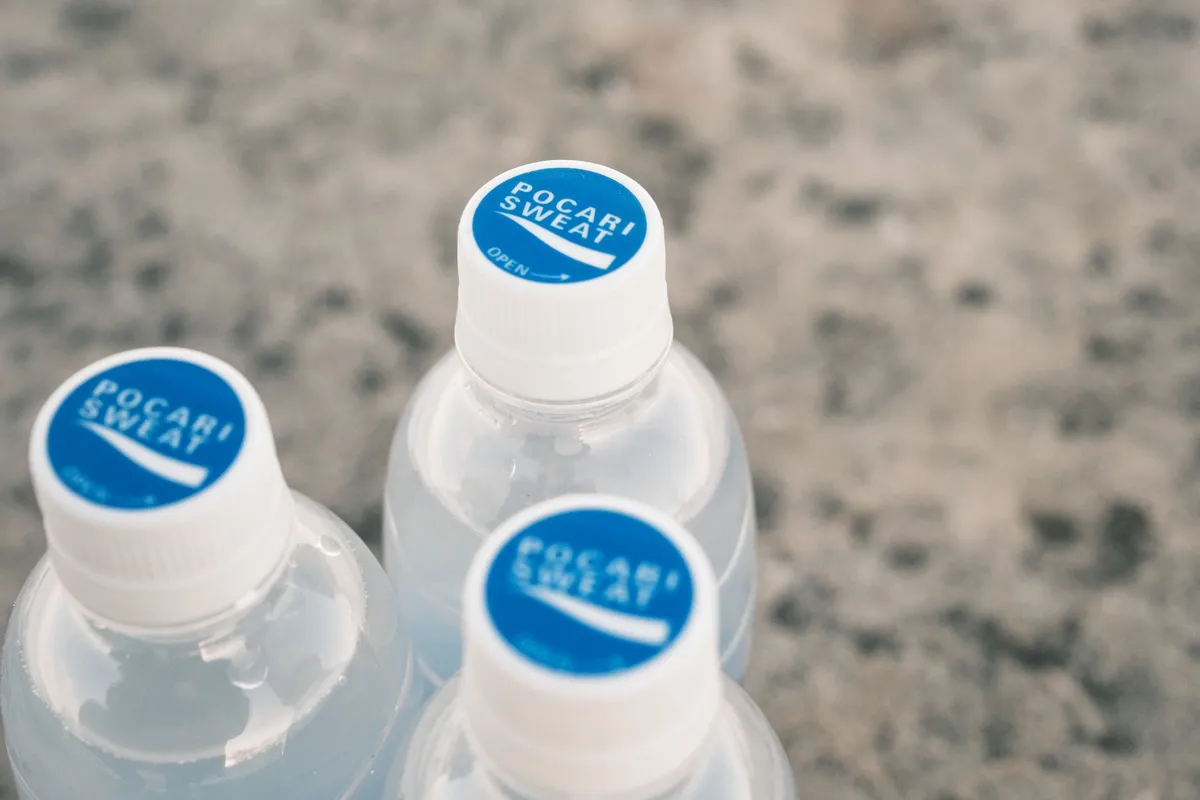
Groundwater carries only trace amounts, but bottled water is a different story. Bottled water from Chinese supermarkets contained microplastics at 27.7–117 particles per liter, and Australian bottled water samples ran 6–32 particles per liter, including polypropylene, PET, polyamide, and polyethylene.[Toxicology Research, 2024] Crucially, the review notes that the amount of microplastic in bottled water can rise significantly from the wear and tear of repeatedly opening, closing, and reusing plastic bottles.[Toxicology Research, 2024]
97,800–223,000
PET microplastic particles per gram — median levels detected in vegetables and fruits
Food and packaging add to the load. The review reports polystyrene and polypropylene in beer, microplastic fibers in tea, particles in milk and salt, and release from takeout meal boxes as they’re handled during delivery.[Toxicology Research, 2024] In liquid products, the detected plastic types run—from most common to least—polyethylene, PET, polypropylene, and polystyrene.[Toxicology Research, 2024]
How the particles get in—and where they end up
The review traces three entry routes: swallowing, inhaling, and, to a lesser degree, absorption through skin.[Toxicology Research, 2024] Once inside, particles don’t just pass through.
Microplastics have been detected in human colectomy specimens and in the lung tissue of nonsmoking patients, confirming both the digestive and respiratory routes.[Toxicology Research, 2024] From there, they reach the bloodstream: MNPs at least 700 nanometers across have been found in the whole blood of healthy people, including PET at 2.4 µg/mL, polyethylene at 7.1 µg/mL, and polystyrene at 4.8 µg/mL.[Toxicology Research, 2024]
The list of tissues where particles have shown up is sobering: liver tissue of cirrhosis patients, human saphenous vein, the hearts of patients undergoing cardiac surgery, kidney tissue, breast milk, sputum, semen, and feces.[Toxicology Research, 2024] The review also notes that nanoplastics small enough to enter the bloodstream can cross the blood–brain barrier and accumulate in the frontal cortex.[Toxicology Research, 2024]
Key takeaway
The review reaches the most consequential point plainly: microplastics can move from a pregnant mother across the placenta to her offspring. Polystyrene nanoplastics were shown to cross the placental barrier and accumulate before being passed on—which is why the authors call for long-term growth tracking of newborns.[Toxicology Research, 2024]
The part most coverage skips: harm at real-world doses
Here’s where this review earns its place. Plenty of studies dose cancer cell lines with high plastic concentrations and report damage. Those results are easy to dismiss because tumor cells behave abnormally and the doses are unrealistic. This review deliberately concentrated on normal tissue cells and organoids, which the authors argue are far closer to what happens in a living body.[Toxicology Research, 2024]
Across normal human cell types—lung (BEAS-2B), liver (L02), intestinal, kidney (HEK293), blood, skin, and others—MNP exposure produced effects including reduced cell viability, increased reactive oxygen species, mitochondrial damage, metabolic disorders, inflammatory responses, and, in blood lymphocytes, chromosomal aberrations and genomic instability.[Toxicology Research, 2024]
The review is careful to distinguish which of these results occurred at doses below environmental levels—the ones that matter—versus doses above them. Using reference concentrations of roughly 15 µg/mL in blood, 40 µg/mL in water, 0.7 ng/mL in air, and 2 mg/g in polyester clothes, the authors conclude that MNPs can cause toxicological damage to several normal cell types (including colon fibroblasts, liver cells, dendritic cells, kidney cells, keratinocytes, endothelial cells, and mesenchymal stromal cells) at or below what we’re actually exposed to.[Toxicology Research, 2024]
What organoids add to the picture
Organoids—miniature tissues grown from human stem cells—sit even closer to real physiology than isolated cells. The review summarizes several findings at doses below the 40 µg/mL water reference.
In brain (cortical) spheroids, polystyrene microplastics decreased cell viability and the expression of neural markers, pointing toward neurotoxicity.[Toxicology Research, 2024] In intestinal organoids, 50-nanometer polystyrene nanoplastics entered cells and induced apoptosis and inflammatory responses.[Toxicology Research, 2024] In liver organoids, polystyrene microplastics at just 0.25 µg/mL reduced viability, promoted apoptosis, and disrupted lipid metabolism—effects the authors link to the risks of liver steatosis, fibrosis, and cancer.[Toxicology Research, 2024] That effect got worse when the plasticizer bisphenol A was added alongside the plastic.[Toxicology Research, 2024]
The honest limitations
A credible read of this review requires holding two things at once.
Caution
Not every alarming lab result maps onto daily life. The review repeatedly notes that some of the most dramatic effects were produced at concentrations higher than real-world exposure—for example, several lung and blood-cell effects used doses well above the 0.7 ng/mL air reference or the 15 µg/mL blood reference, making harm from those specific experiments unlikely in everyday conditions.[Toxicology Research, 2024] The authors say so directly, and that candor is part of what makes the review trustworthy.
Two other gaps are worth naming. First, this is a review of cell and organoid studies, not proof of disease in living people—it maps plausible mechanisms, not confirmed clinical outcomes. Second, the evidence base is lopsided: most toxicology to date uses polystyrene, while polypropylene and polyethylene—the plastics most common in daily life—remain understudied, and nanoplastic versions of them have barely been examined.[Toxicology Research, 2024]
What a reader should take from this
The review’s practical thrust is not panic; it’s proportion. The particles are demonstrably inside human tissue, and at least some cellular harm shows up at exposure levels we already live with. Nanoplastics deserve the most concern, because their small size lets them enter cells and cross the blood–brain barrier.[Toxicology Research, 2024]
For hydration specifically, the review’s own data offers a straightforward lever: bottled water carries measurable microplastic loads, and repeatedly reusing and reopening plastic bottles increases that load through mechanical wear.[Toxicology Research, 2024] Reducing reliance on single-use plastic bottles—especially reused ones—directly targets one of the exposure routes the authors document. The strongest scientific caveat is also the fairest: much of the highest-dose lab evidence overstates everyday risk, and the real answer for long-term human health, as the authors themselves conclude, still depends on studies that use real-world concentrations and track exposed people over time.[Toxicology Research, 2024]
Sources
- Toxicology Research, 2024 Impact of micro-nano plastics in daily life on human health: toxicological evaluation from the perspective of normal tissue cells and organoids Read the source ↗
Frequently asked questions
- Can microplastics really get into human blood?
- Yes. A 2024 review notes that particles at least 700 nanometers across have been found in the whole blood of healthy people, including polyethylene terephthalate, polyethylene, and polystyrene.
- Do microplastics reach an unborn baby?
- The evidence points that way. The review reports that polystyrene nanoplastics can cross the placental barrier and accumulate there before being passed to offspring, and that placental particle levels correlate with reduced fetal growth.
- Which plastics are the most common in the things I drink?
- In liquid products like drinking water and beverages, the review ranks the detected types from most to least common as polyethylene, PET, polypropylene, and polystyrene.
More on The Science of Plastic
The Science of Plastic
Why Nanoplastics in Drinking Water Are So Hard to Measure
Nanoplastics have been found in tap and bottled water, but the numbers are hard to trust. The real problem is measurement science, not just contamination.

The Science of Plastic
How Many Microplastics Are in Bottled Water? A New Count
A 2026 study counted up to 12,080 microplastic particles per liter of bottled water and showed they can slip inside human cells. Here is what the numbers mean.

The Science of Plastic
What 240,000 Microplastics Per Liter Actually Means For Your Body
The bottled-water stat gets quoted constantly. Here's where those particles actually go once you swallow them, and what's still genuinely unknown.