The Science of Plastic
Microplastics Reach the Arctic — and Humans Bring Them
A 2023 study north of the Arctic Circle found microplastic in every water sample tested, and traced lake contamination directly to the nearest human settlement.
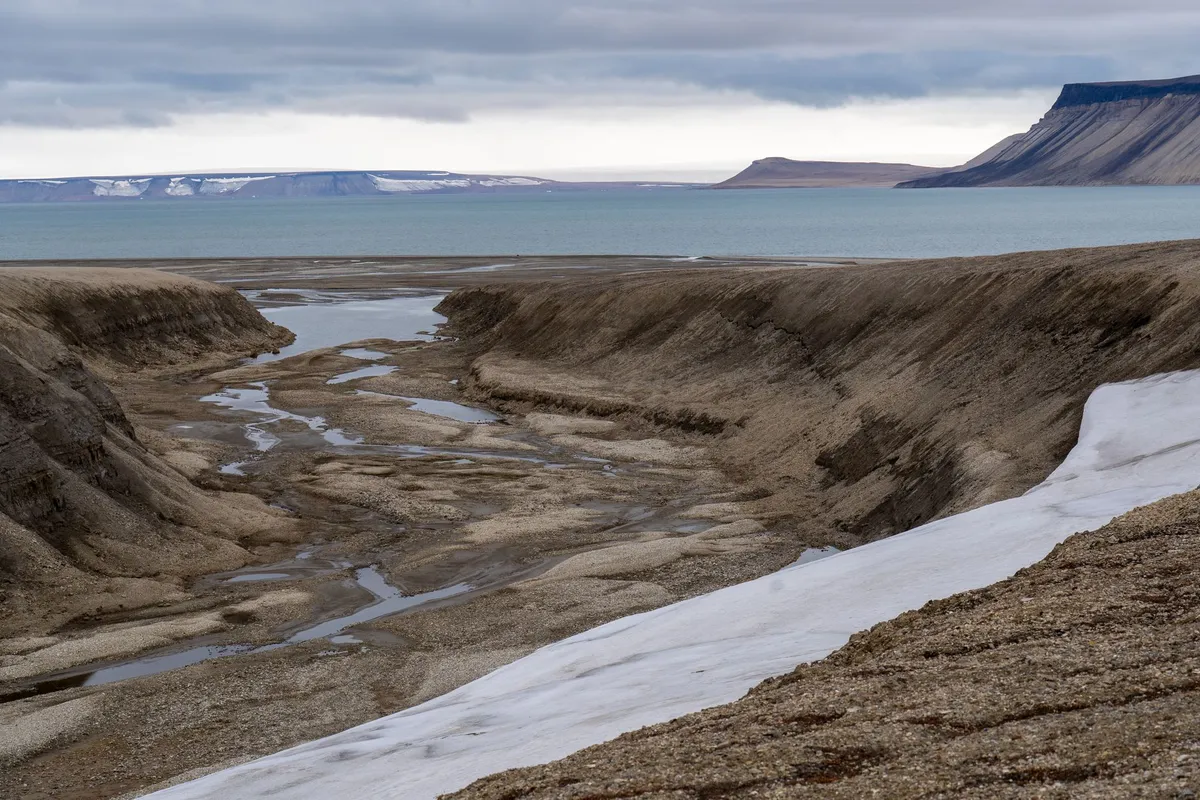
Microplastics have been found from the deep sea to drinking water, but one question keeps returning: can a place with almost no people still be polluted? A 2023 study from the Kola Peninsula — a remote, scarcely populated region of Arctic Russia north of the Arctic Circle — answers it plainly. [Biology, 2023] Microplastics turned up in every water sample the researchers collected, from ocean bays and isolated tundra lakes alike.
More striking than their presence was their pattern. In the lakes, contamination tracked with the distance from a single field station inhabited by a few dozen people. The closer the lake, the more plastic fiber in the water. That is the first time such a direct link between microplastic levels and human presence has been reported in a remote region. [Biology, 2023]
The takeaway is uncomfortable: even occasional, small-scale human activity leaves a plastic signature on the most isolated ecosystems on Earth.
Plastic in every sample, sea and lake alike
The researchers sampled six bays of the Barents Sea and three freshwater lakes in the tundra, using a fine 20-micron plankton net designed to catch even small particles. Nothing came back clean.
In the Barents Sea bays, contamination ranged from 1,500–4,170 fibers per cubic meter plus 420–1,600 fragments per cubic meter. [Biology, 2023] In the lakes, fiber counts ran 1,100–3,300 per cubic meter — a similar scale to the sea, despite the lakes being isolated bodies of water in the tundra. [Biology, 2023]
1,300–4,800
microplastic items per cubic meter of water across all sites sampled
Notably, the authors found these Arctic waters more contaminated than some previously reported polar waters — by one to two orders of magnitude in certain comparisons. [Biology, 2023] They attribute part of this difference to method: their fine 20-micron mesh captured far smaller particles than the 125–330 micron nets used in many earlier studies, and finer filtering reveals more, smaller microplastics. [Biology, 2023]
Note
Comparing microplastic counts across studies is genuinely difficult. Differences can reflect the real distribution of plastic — or simply the mesh size of the net. The authors are explicit that their finer net is part of why their numbers run high, which is exactly the kind of caveat that makes a result more trustworthy, not less.
Fibers, not fragments, dominate
Across both environments, one form of plastic prevailed: fibers. They made up 76 ± 4% of the microplastics in the sea and 83 ± 2% in the lakes. [Biology, 2023] Fragments were the minority, and where they occurred they were overwhelmingly small — 97 ± 5% of sea fragments and 93 ± 10% of lake fragments fell in the smallest size class (0.01–0.20 mm). [Biology, 2023]
This mirrors a broad pattern in polar research: fibers repeatedly turn out to be the dominant component of microplastic in remote water, sediment, ice, and snow. [Biology, 2023] Their shape is part of the reason — thin, light fibers travel readily through air and water, which helps them reach places people rarely go.
PET and rayon point back to clothing and gear
Using Raman spectroscopy to identify the polymers, the team found the same two materials dominating both the sea and the lakes. On average, 67% of the fibers in the bays and 60% in the lakes were polyethylene terephthalate (PET) — the most common thermoplastic in the polyester family. [Biology, 2023] The remaining fibers were largely rayon, a semi-synthetic cellulose-based material. [Biology, 2023]
Both point to everyday human materials. PET fibers are used in fleece, woven fabrics, sailcloth, and rope; the authors note that around 70% of synthetic fibers by production volume are PET. [Biology, 2023] The likely local sources — ship equipment, fishing nets, and protective clothing — were all observed in and around the field station. [Biology, 2023]
Rayon is sometimes assumed to be gentler because it is cellulose-based, but the study pushes back on that comfort. Rayon has been reported as one of the most frequently detected microfibers inside marine organisms, found in fish guts and identified as the most common fiber (53%) in a True’s beaked whale. [Biology, 2023] Even fibers derived from natural cellulose can carry dyes, plasticizers, and flame retardants. [Biology, 2023]
The human-presence signal — and where it breaks down
The study’s headline finding is the correlation in the lakes. When the researchers compared the three tundra lakes, the number of microfibers fell significantly as distance from the field station grew (Pearson’s r = −0.73, p = 0.02). [Biology, 2023] The lake nearest the station carried the most fiber; the farthest carried the least. To the authors’ knowledge, this is the first paper to demonstrate such a direct relationship between freshwater microplastic and human presence in a remote region. [Biology, 2023]
The station houses only a few dozen people, and there are no other inhabited places for dozens of kilometers around. [Biology, 2023] The most likely delivery mechanism for lakes 2–5 km away is wind — the region sits under the main North Atlantic storm track and has a notably windy climate. [Biology, 2023] The authors point to the local landfill, protective clothing, and wind-borne fibers as the main pathways. [Biology, 2023]
Key takeaway
The correlation held for lakes but not for the sea. In the Barents Sea bays, there was no significant relationship between contamination and distance from the station — the authors attribute this to the Norwegian Current, which mixes and imports plastic from far beyond the local area. In other words, ocean currents wash out the local human signal that stays visible in still tundra lakes.
This is an important nuance. It would be easy to overread the study as “people directly pollute nearby water everywhere.” The evidence is more specific: the human-presence signal is detectable in enclosed freshwater lakes, while in the open sea, large-scale transport dominates and obscures any local footprint.
The honest limitations
The researchers ran negative controls, and they matter. Microplastic contamination from the sampling method itself may account for around 12% of what was detected, and those method-driven particles were all fibers, mostly medium-sized. [Biology, 2023] No microplastic was found during the laboratory air-exposure control. [Biology, 2023] The team also distinguished their net’s own fibers — transparent, oval, 34.5 microns wide — from the colored, ribbon-shaped, 10–24 micron fibers in the field samples, reducing the chance of confusing the two. [Biology, 2023]
Acknowledging that roughly one in eight detected particles could be procedural background is exactly the kind of transparency that separates careful microplastics work from alarmist headlines. It does not erase the finding — plastic was in every sample and correlated with human presence — but it frames the numbers honestly.
Why this matters beyond the Arctic
The Barents Sea is one of the most productive seas in the world, feeding copepods, commercial fish stocks like cod, capelin, and herring, and on up to seabirds, seals, and whales. [Biology, 2023] Microplastic in that food web is a concern at every trophic level, including humans. [Biology, 2023] Filter-feeders and planktivores can mistake fibers for prey, and there is documented evidence of trophic transfer of microplastic from mussels to crabs. [Biology, 2023] Polar animals may be especially vulnerable: their fat-rich tissues can make them prone to the toxicological effects of pollutants carried on plastic, on top of existing stress from warming and acidification. [Biology, 2023]
For the reader, the practical lesson is less about the Arctic and more about the source. The plastics found in these pristine lakes came overwhelmingly from textiles and gear — synthetic clothing shedding fibers through normal wear, then traveling on the wind. Reducing what sheds at the source is where the leverage is. The authors’ own recommendations for the station are mundane and telling: sort waste, secure the landfill, and carry plastic waste back to a city with processing facilities. [Biology, 2023]
If a settlement of a few dozen people leaves a measurable plastic trail across Arctic tundra lakes, no environment is genuinely out of reach. That is the sentence worth remembering.
Sources
- Biology, 2023 First Evidence of Microplastic Occurrence in the Marine and Freshwater Environments in a Remote Polar Region of the Kola Peninsula and a Correlation with Human Presence Read the source ↗
Frequently asked questions
- Are remote environments free of microplastics?
- No. A 2023 study of the remote Kola Peninsula north of the Arctic Circle detected microplastics in every single water sample collected from both the Barents Sea and isolated tundra lakes.
- What kind of plastic showed up most in Arctic waters?
- Fibers dominated, making up 76–83% of the microplastics found. Most were polyethylene terephthalate (PET) — the polyester used in clothing, ropes, and fishing nets — followed by semi-synthetic cellulosic rayon.
- Does a small human presence really matter for pollution?
- Yes. In the studied lakes, the number of microfibers fell as distance from a field station of a few dozen people increased — the first reported correlation of this kind in a remote region.
More on The Science of Plastic

The Science of Plastic
Why Nanoplastics in Drinking Water Are So Hard to Measure
Nanoplastics have been found in tap and bottled water, but the numbers are hard to trust. The real problem is measurement science, not just contamination.

The Science of Plastic
How Many Microplastics Are in Bottled Water? A New Count
A 2026 study counted up to 12,080 microplastic particles per liter of bottled water and showed they can slip inside human cells. Here is what the numbers mean.

The Science of Plastic
What 240,000 Microplastics Per Liter Actually Means For Your Body
The bottled-water stat gets quoted constantly. Here's where those particles actually go once you swallow them, and what's still genuinely unknown.