The Science of Plastic
Hot Cars and Bottled Water: How Storage Multiplies Plastic Release
Heat and shaking can boost nanoplastic release from PET water bottles more than nine-fold. How you store bottled water may matter as much as what's in it.
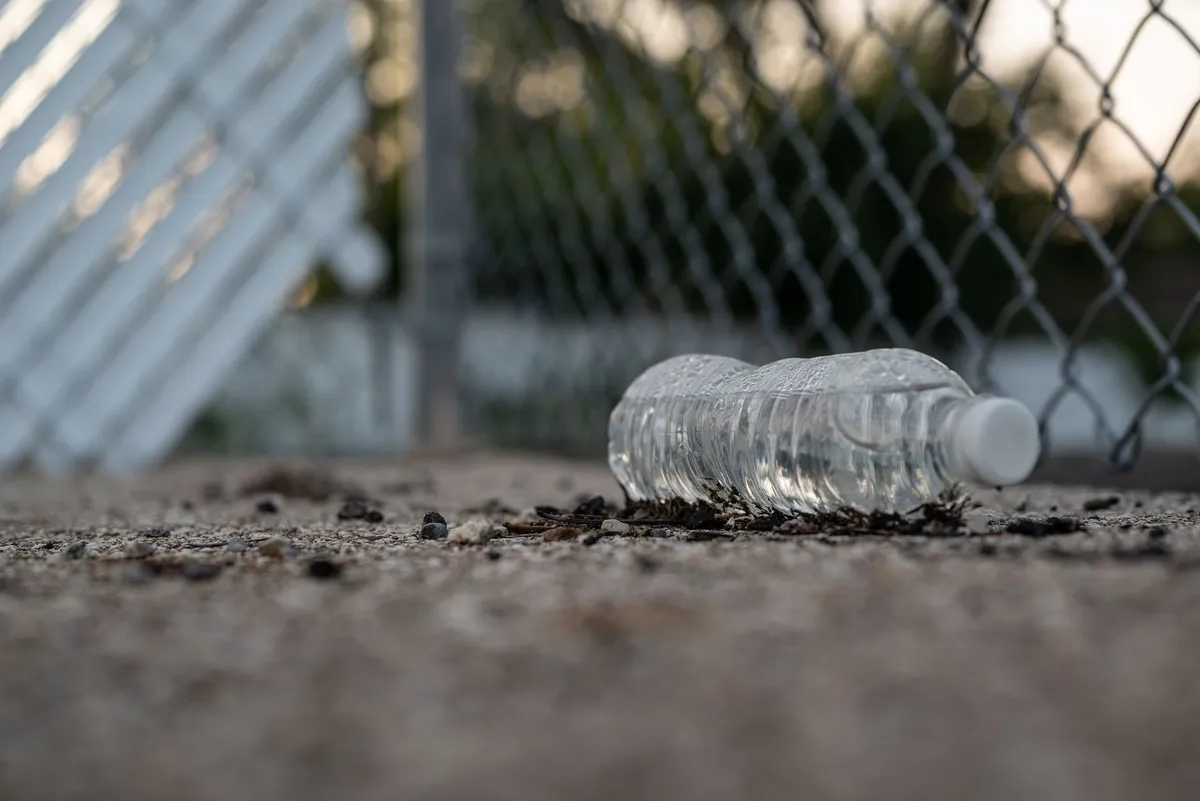
Most conversations about microplastics in bottled water focus on what’s already inside the bottle when you buy it. A 2026 study in Water Research points somewhere else: at how you store and handle the bottle after purchase.[Water Research, 2026]
The finding that stands out is a multiplier. When researchers exposed single-use PET bottles to a combination of heat and mechanical shaking — conditions meant to mimic a bottle riding around in a hot car — nanoparticle concentrations rose by as much as 9.29-fold, and microparticle concentrations also rose significantly.[Water Research, 2026] Neither heat nor shaking alone did much. It was the combination that mattered.
That distinction is the practical core of this research: exposure isn’t just about the product, it’s about the everyday behavior around it.
What the researchers actually tested
The team selected eight of the most popular single-use bottled-water brands in the United States, together accounting for over 50% of the still-water market share. All were 500 mL PET bottles of unflavored still water.[Water Research, 2026]
Rather than testing pristine lab conditions, they built experiments around real consumer scenarios: bottles left in hot cars, jostled during driving, stored outdoors through summer heat or winter freezes. Specific conditions included exposure to 60°C for 12 hours, freezing at −12°C for 24 hours, shaking at 200 rpm, and a combined heat-plus-shaking condition. They also ran 15-day temperature-cycling experiments to simulate prolonged outdoor storage.[Water Research, 2026]
The 60°C target wasn’t arbitrary. The authors note that field studies have measured vehicle interiors reaching 40–75°C depending on weather and season, making 60°C an extreme but realistic upper-bound exposure.[Water Research, 2026]
9.29×
Increase in nanoparticle concentration under combined heat and shaking (60°C, 200 rpm)
The combination is the problem
The single most useful takeaway is that stressors compound. When the researchers isolated the variables on the five most responsive brands, shaking alone at room temperature did not significantly change nanoparticle or microparticle levels. Heating alone produced only a weak, non-significant upward trend.[Water Research, 2026]
Put the two together, and the picture changed sharply. The combined heat-and-shaking condition was the only scenario to produce a statistically significant increase in both particle types at once: nanoparticles rose with a t-statistic of 4.06 (p = 0.015) and microparticles with a t-statistic of 2.86 (p = 0.045).[Water Research, 2026]
The authors’ conclusion is direct: neither high temperature nor mechanical agitation alone is sufficient to induce substantial release. It’s the two together — the exact profile of a water bottle in a moving vehicle on a hot day — that drives the most pronounced release of nano- and microplastics.[Water Research, 2026]
Cold isn’t automatically safe
It would be convenient if freezing simply sidestepped the problem, but the data don’t fully support that. A single 24-hour freezing event produced only a modest, statistically non-significant rise in nanoparticles, and no significant change in microparticles.[Water Research, 2026]
Prolonged exposure told a different story. Over 15 days of freeze-thaw cycling, nanoparticle concentrations increased 2.0- to 4.2-fold across all four brands tested, a statistically significant result (p = 0.026). Microparticles, however, showed only a modest and non-significant increase.[Water Research, 2026]
The researchers attribute this to repeated mechanical stress from water expanding during each freeze — small microfractures and surface wear accumulating cycle after cycle. Larger microparticles, more structurally locked into the polymer, appear less sensitive to this kind of cyclic stress than the smaller nanoparticles.[Water Research, 2026]
High-temperature cycling over the same 15-day window followed a similar pattern, increasing nanoparticle concentrations 2.1- to 5.7-fold across brands, with a p-value of 0.075 suggesting a trend toward significance.[Water Research, 2026]
Where the particles come from
Using Raman spectroscopy, the team identified the polymer types in the released particles. In baseline (as-purchased) water, polypropylene dominated: of 40 particles analyzed, 53% were PP, 17% PET, 5% PE, and 25% unidentified.[Water Research, 2026]
After the combined heat-and-shaking treatment, the composition shifted noticeably. PET rose from 17% to 54% of analyzed particles, and PE rose from 5% to 8%.[Water Research, 2026] Because the bottle itself is PET and the cap is PE, this points to both the bottle body and its cap shedding material under combined stress.[Water Research, 2026]
Note
The Raman analysis examined only a small subset of particles — 40 per sample. The authors are explicit that these measurements are qualitative confirmation of PET-derived release, not a quantitative census of the entire particle population. SEM-EDX analysis also confirmed that some of the “unidentified” particles were salt crystals rather than plastic, which is why brand-specific baseline controls were used to isolate plastic release.[Water Research, 2026]
It’s surface wear, not the plastic falling apart
One of the more reassuring — and mechanistically important — findings comes from differential scanning calorimetry (DSC), which the team used to check whether the treatments were degrading the plastic at a deep, structural level.
They weren’t. After the previous thermal history was erased in a second heating cycle, DSC curves for treated and untreated samples closely overlapped, and crystallization behavior on cooling was very similar across samples. Since polymer crystallization is highly sensitive to changes in chain structure, this similarity indicates the treatments did not significantly degrade the bulk polymer.[Water Research, 2026]
Instead, the evidence points to surface-level effects — abrasion and mechanical stress at the bottle’s inner surface — as the driver of release. SEM imaging backed this up, showing only slight surface smoothing, with no cracks or large-scale deformation.[Water Research, 2026] In other words, the bottle isn’t structurally failing; its surface is shedding.
What the survey adds: behavior matters more than income
The study’s second half is what makes it unusual. Alongside the lab work, the authors ran a statewide survey (n = 1,673) as part of the 2023 Nebraska Annual Social Indicators Survey to see how real consumer behavior maps onto exposure risk.[Water Research, 2026]
The demographic factors people might expect to matter mostly didn’t. Population density showed no significant association with bottled water consumption (τb = −0.0212), and household income showed only a weak, non-significant negative association.[Water Research, 2026]
What did stand out was knowledge. Awareness of microplastics was significantly associated with lower bottled water consumption (τb = −0.1355, p < 0.001), as was education level (τb = −0.1209, p < 0.001). Awareness also tracked with safer handling: people aware of microplastics were significantly less likely to expose their bottled water to high temperatures (τb = −0.0992, p < 0.001).[Water Research, 2026]
For context, 52.3% of respondents reported drinking less than 1 oz of bottled water per day, and 72% said they never exposed bottled water to high temperatures — meaning 28% did so with varying frequency.[Water Research, 2026]
The honest limitations
This is a carefully hedged study, and it’s worth reading it that way.
Caution
Several of the individual heating conditions did not reach statistical significance. High-temperature exposure for 12 hours gave p = 0.070, and high-temperature cycling gave p = 0.075 — the authors describe these as trends or marginal evidence rather than firm effects. Only the combined heat-and-shaking condition and the freeze-thaw cycling reached the conventional p < 0.05 threshold for nanoplastics.[Water Research, 2026]
Three of the eight brands had baseline particle concentrations roughly ten times higher than the others — likely due to mineral addition, pH balancing, or natural spring sourcing — which made it hard to detect any additional release against that noisy background. Those brands were excluded from the main conclusions, so the core findings rest on five brands.[Water Research, 2026] The survey was also conducted in a single U.S. state, which limits how far its behavioral patterns can be generalized.
None of this undermines the central result. It sharpens it: the clearest, most statistically robust signal was the combination of heat and mechanical stress.
What to actually do
The authors translate their findings into concrete guidance. The practical steps that follow directly from the data:[Water Research, 2026]
- Don’t leave bottled water in parked cars, direct sunlight, or other high-heat settings. This is the specific scenario — heat plus vibration — that produced the largest release.
- Avoid prolonged outdoor storage through temperature swings. Repeated freeze-thaw and heat cycling over 15 days both significantly raised nanoparticle levels.
- Consider reusable alternatives in high-heat situations. The authors specifically name glass or stainless steel bottles as options that may reduce exposure in high-heat scenarios.
The broader message from the survey half of the study is that awareness itself is protective. The people least exposed weren’t the wealthiest — they were the ones who knew about the issue and adjusted their habits accordingly.[Water Research, 2026]
Sources
- Water Research, 2026 Everyday storage and handling of PET bottled water increase human exposure to nano- and microplastics: Influence of socio-economic factors Read the source ↗
Frequently asked questions
- Does leaving bottled water in a hot car really increase plastic release?
- In this study, heat alone produced only a weak, non-significant increase in nanoparticles. But heat combined with the shaking a bottle experiences in a moving car raised nanoparticle concentrations up to 9.29-fold and significantly increased microparticles, according to Water Research, 2026.
- Is freezing bottled water safer than heating it?
- A single 24-hour freeze produced no statistically significant change. However, repeated freeze-thaw cycling over 15 days did significantly raise nanoparticle concentrations, per Water Research, 2026, so prolonged winter storage is not risk-free either.
- What can I do to reduce my exposure?
- The study's authors suggest avoiding leaving bottled water in parked cars, direct sunlight, or other high-heat settings, and consider reusable glass or stainless steel bottles in high-heat scenarios, according to Water Research, 2026.
More on The Science of Plastic
The Science of Plastic
Why Nanoplastics in Drinking Water Are So Hard to Measure
Nanoplastics have been found in tap and bottled water, but the numbers are hard to trust. The real problem is measurement science, not just contamination.

The Science of Plastic
How Many Microplastics Are in Bottled Water? A New Count
A 2026 study counted up to 12,080 microplastic particles per liter of bottled water and showed they can slip inside human cells. Here is what the numbers mean.

The Science of Plastic
What 240,000 Microplastics Per Liter Actually Means For Your Body
The bottled-water stat gets quoted constantly. Here's where those particles actually go once you swallow them, and what's still genuinely unknown.